
· 4 min read · Updated 31 Aug 2026
By Correct Editorial — Compliance Research Desk
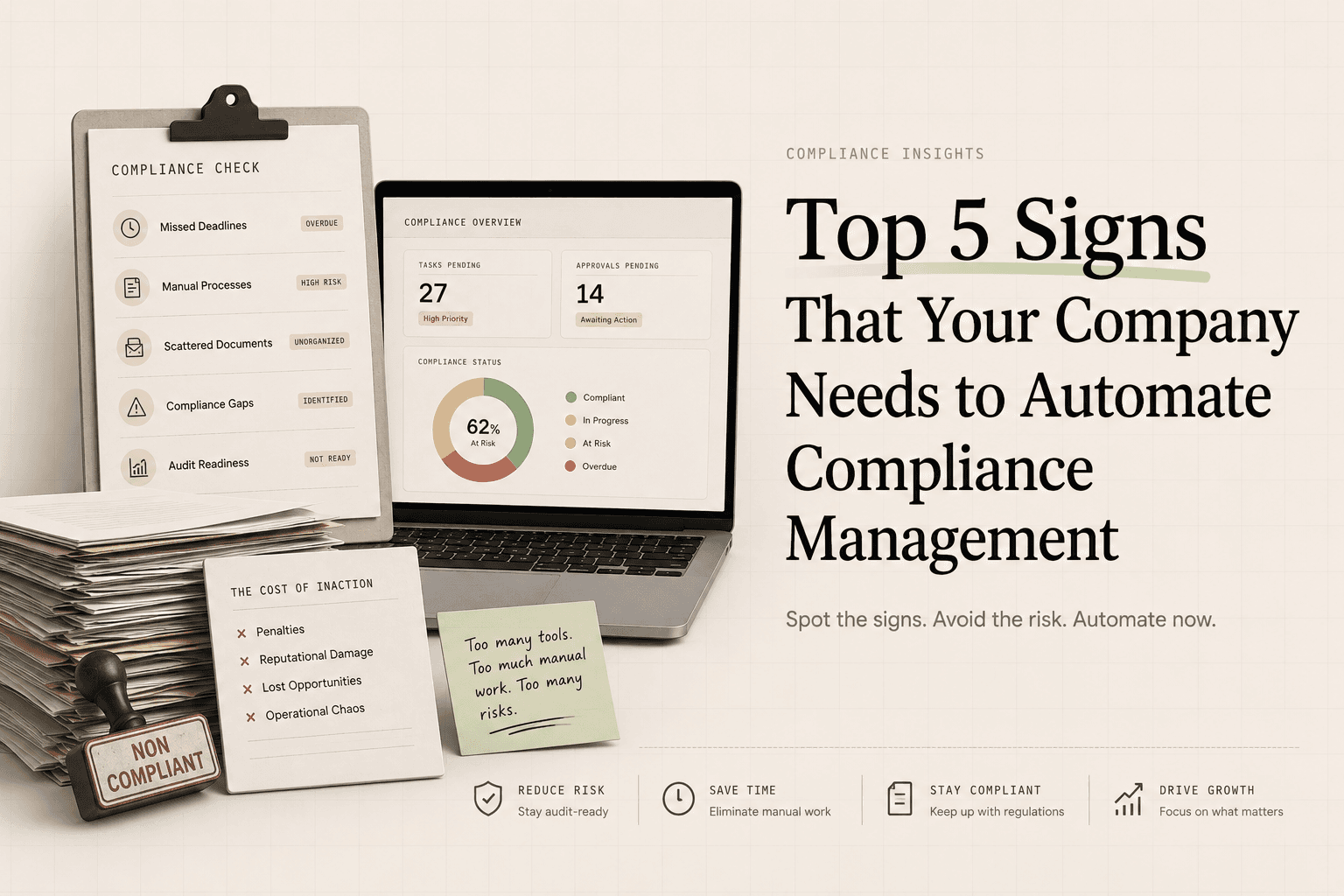
Top 5 Signs That Your Company Needs to Automate Compliance Management
Published on: April 30, 2025
Compliance management in India is complex and demands expertise. The country has:
- Over 1,536 Acts
- 69,233 compliances
- 6,618 filings
To make things more challenging, the regulatory ecosystem is fluid, with changes occurring at least 15 times a day. Despite this, many compliance officers still operate in ad-hoc, paper-based, and people-dependent environments.
While the Companies Act, 2013 makes the board and management legally liable for non-compliance, most organizations lack the tools, processes, and trained personnel to manage their compliance programs effectively. Digitizing compliance tracking is the essential first step toward building a strong compliance foundation.
When Should You Consider Automating Compliance Management?
Here are the top five signs that it's time to digitize your compliance program:
1) You Are Consistently Missing Critical Compliances
A typical Indian manufacturing company with operations across multiple states must manage:
- Registrations, licenses, and permissions
- Consent orders and renewals
- Maintenance of registers and returns
Over 30% of these compliances are high-risk, and missing them can lead to operational, financial, and reputational damage.
2) You Are Receiving Several Notices
As part of the Digital India initiative, government departments are becoming more capable of:
- Detecting missed or incomplete compliances
- Issuing notices and initiating legal proceedings
This leads to litigation, which consumes management bandwidth and distracts from core business activities.
3) You Are Missing Critical Compliance or Legal Updates
With laws changing about 15 times a day, India sees over 2,500 regulatory changes annually. These changes impact:
- Forms
- Penalty structures
- Filing deadlines
- Interest computations
Missing these updates can lead to inadvertent non-compliance and regulatory penalties.
4) You Operate in Multiple Geographies (States / UTs / Cities)
India’s compliance obligations are governed by:
- Central Government
- State Governments
- Union Territories
- Local Authorities
The more locations your business operates in, the higher the complexity. Managing this without a digital platform often exceeds in-house expertise.
5) You Are Doing Business with International Customers
There’s increasing emphasis on vendor compliance in global markets. International buyers now demand:
- Evidence of corporate compliance
- Risk management protocols
- Sustainability and ethical standards
Failure to meet these expectations can result in loss of business or vendor delisting.
The Case for Compliance Automation
The world has changed dramatically, and technology is now a key enabler of:
- Transparency
- Accountability
- Timely compliance management
Tools powered by Cloud, Mobile, Analytics, AI, and ML can digitize and transform compliance workflows.
- Digital compliance platforms are available for less than the salary of a junior compliance officer.
- Onboarding can take just 3–4 weeks.
- They help reduce human error and improve control and oversight.
With regulatory scrutiny increasing and penalties escalating, going digital is no longer optional—it's a necessity.
Now is the time to review your compliance program and embrace digitization.
Where to Start: Auditing What You Actually Owe
Most compliance programmes fail before automation is even considered, because nobody has written down the full obligation set. A review is worth doing in this order.
1. List the entities, not the business. Obligations attach to registered entities, not to trading names. A group with a parent, a subsidiary and an LLP has three obligation sets, even where one team runs all three.
2. List the locations. Registrations, licences and returns follow physical presence. A warehouse in a second state creates obligations that the head office register will not show.
3. List the headcount thresholds you have crossed. Several obligations switch on at a specific number of employees rather than on turnover, and they do not announce themselves when you cross them.
4. Attach an owner and a due date to every item. An obligation with no named owner is, in practice, unowned. This is the step that converts a list into a programme.
5. Attach the consequence. Recording what a slip costs changes how deferrals get decided, because the trade-off becomes explicit rather than assumed.
What to Look for in a Compliance Platform
Once the list exists, the question becomes what should hold it. Three capabilities separate a system from a shared spreadsheet.
- It derives obligations rather than storing them. If you have to type in what applies to you, the tool inherits every gap in your own knowledge.
- It keeps the evidence with the obligation. A filing you cannot produce evidence for is, under audit, indistinguishable from one you never made.
- It tells you what changed. Given the pace of regulatory change described above, a system that only tracks what you entered last year will quietly go stale.
For a fuller treatment of why these programmes stall even when the tooling is good, see a culture of compliance is the key to compliance automation. For the obligations themselves, the annual compliance calendar for Indian companies is a practical starting point, and the challenges compliance officers face covers what the role runs into structurally.
Frequently asked questions
- How large is India's compliance load for a single company?
- The Indian regulatory universe covers over 1,536 Acts, 69,233 compliances and 6,618 filings. It is also unusually fluid: changes occur at least fifteen times a day, amounting to more than 2,500 regulatory updates a year affecting forms, penalty structures, filing deadlines and interest computations. No single person can hold a current picture of that surface in their head.
- What are the signs a company should automate compliance management?
- Five signals recur. You are consistently missing critical compliances, of which roughly thirty percent are high risk. You are receiving several notices. You are missing compliance or legal updates. You operate across multiple states, union territories or cities, each adding its own obligations. Or you sell to international customers who now ask for evidence of corporate compliance before they will buy.
- Who is legally liable when a company misses a compliance?
- The Companies Act, 2013 places legal liability for non-compliance on the board and management, not on whoever happened to be tracking the deadline. That is the gap most organisations run: liability sits at the top while the process underneath is ad hoc, paper-based and dependent on individual people remembering.
- Why does operating in several states make this harder?
- Obligations in India are set at four levels at once: central government, state governments, union territories and local authorities. Each additional location a business operates in multiplies the applicable set rather than adding to it, and the combined requirement routinely exceeds what in-house teams can track without a system.